Resting metabolic rate testing helps you understand how much energy your body uses before exercise, movement, or daily activity is added.
This baseline matters. If you are trying to lose weight, maintain your current body composition, build muscle, or support training performance, your nutrition strategy needs to start with a realistic understanding of your energy needs.
At HOOKE in Mayfair, resting metabolic rate testing uses indirect calorimetry to measure your oxygen consumption and carbon dioxide production while you rest. This gives a measured view of your baseline metabolism, rather than an estimate based on a standard equation.
For people managing busy schedules in Mayfair and central London, this can make nutrition planning more practical, more precise, and easier to sustain.
What Is Resting Metabolic Rate Testing?
Resting Metabolic Rate, or RMR, is the amount of energy your body uses at rest.
This energy supports essential functions such as breathing, circulation, temperature regulation, organ function, and cellular repair. It is the baseline your body needs before you account for walking, working, training, commuting, or other daily activity.
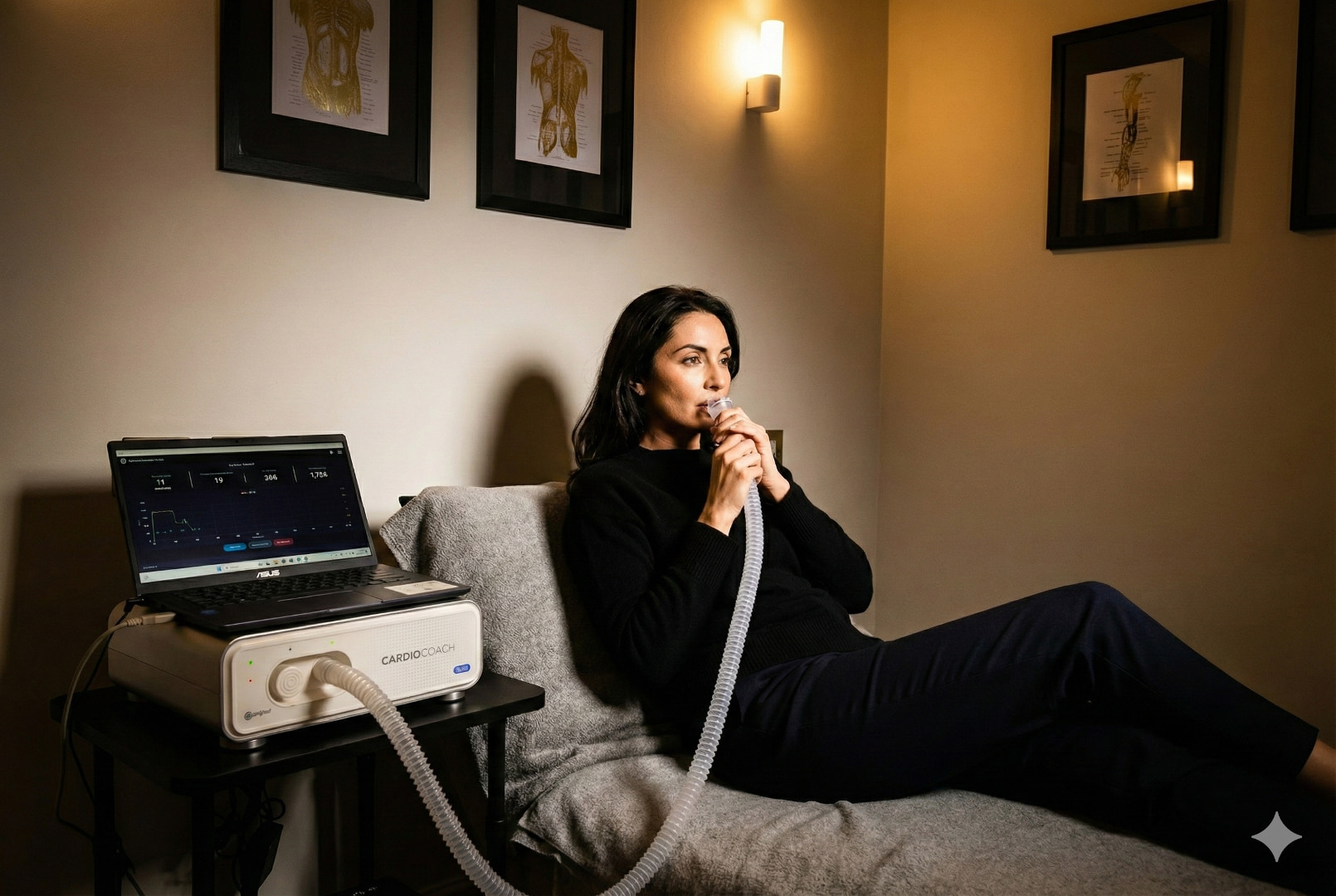
During an RMR test, you wear a lightweight gas-exchange mask while resting comfortably. The mask measures how much oxygen you take in and how much carbon dioxide you breathe out. This information is then used to calculate your resting energy expenditure.
The result is a clearer picture of your baseline metabolism and a stronger starting point for nutrition planning.
Why RMR Testing Is Useful
Many nutrition plans begin with estimated calorie targets.
These estimates can be helpful, but they are not always accurate enough for the individual. Two people of the same age, height, weight, and activity level may still have different metabolic rates. Lifestyle, body composition, training history, stress, sleep, and health status can all influence energy needs.
RMR testing gives you a more personal starting point.
This is especially useful if you have been consistent with nutrition or training but are not seeing the expected changes. It can help clarify whether your current intake is aligned with your goal, or whether your plan needs adjusting.
The Benefits of Resting Metabolic Rate Testing
RMR testing helps define your baseline calorie needs.
From there, your intake can be adjusted depending on your goal. This may include a controlled deficit for weight loss, a maintenance target for stability, or a surplus to support muscle gain.
The aim is not to create a rigid diet. It is to give you a clearer framework so your nutrition decisions are based on your physiology.
More Sustainable Weight Management
Weight management often becomes difficult when calorie targets are too aggressive, too vague, or based on guesswork.
With RMR data, your plan can be built around a more realistic starting point. This can help avoid unnecessary restriction and support a more consistent approach over time.
For clients in Mayfair balancing long working days, travel, and meals out around areas such as Grosvenor Square, and central London, sustainability is often the difference between short-term effort and long-term progress.
Better Support for Training and Recovery
Nutrition affects how you train, recover, and adapt.
If your energy intake is too low, you may notice reduced performance, slower recovery, lower motivation, or difficulty maintaining consistency. If your intake is higher than needed for your goal, changes in body composition may be slower than expected.
RMR testing can help align nutrition with the demands of your training programme, whether you are strength training, preparing for an event, or increasing your overall activity.
Useful Insight When Progress Has Stalled
A plateau can be frustrating, particularly when you feel you are doing the right things.
RMR testing can help provide context. Your result may show that your current calorie target needs adjusting, or that your plan should account more carefully for activity, recovery, or training load.
It does not replace coaching or nutrition support, but it gives both you and your practitioner better information to work from.
What Happens During the Test?
Your RMR test at HOOKE is a 30-minute appointment in a calm, private Mayfair setting.
You arrive fasted and rested, then recline comfortably while wearing a lightweight gas-exchange mask. The test itself usually involves 15 to 20 minutes of quiet measurement under resting conditions.
During this time, the equipment measures your oxygen intake and carbon dioxide output. These values are used to calculate your resting metabolic rate and produce a daily calorie figure.
Your session includes:
- Resting metabolic rate measurement via indirect calorimetry
- Baseline metabolism data
- Personalised daily energy targets
- Calorie guidance for weight loss, maintenance, or weight gain
- A clear report outlining your results
The process is non-invasive and straightforward. The main requirement is that you arrive properly prepared so the result reflects your true resting state.
How to Prepare for Your Appointment
Preparation directly affects the accuracy of your RMR test.
Before your appointment, avoid food and drink, except water, for 12 hours. You should also avoid caffeine, nicotine, and intense exercise for 24 hours before testing.
Arrive well-hydrated, but do not eat a heavy meal or train on the day of your test. Eating beforehand can influence the gas-exchange measurement and may lead to an inaccurate result.
Good preparation allows the test to capture your resting baseline rather than the effect of digestion, stimulants, or recent exercise.
RMR Testing vs Calorie Calculators
Calorie calculators use prediction equations.
They estimate your needs based on factors such as age, height, weight, sex, and activity level. These tools can be useful for broad guidance, but they cannot measure your metabolism directly.
RMR testing is different because it assesses respiratory exchange under controlled conditions. This gives a more individualised view of your resting energy use.
For someone training in Hyde Park, working near Brook Street, or managing a demanding Mayfair routine, that distinction can be useful. The more accurate the starting point, the easier it becomes to build a nutrition plan that fits real life.
Why Your Metabolism May Not Match Your Expectations
Many people are surprised when their measured metabolic rate does not match what they expected.
Some assume they have a slow metabolism because weight loss has been difficult. Others may believe they need far more food because they train regularly, only to find their baseline energy needs are lower than expected. In both cases, the issue is not about being right or wrong. It is about having clearer information.
Your metabolism is influenced by several factors, including body size, lean muscle mass, age, training history, sleep quality, stress, dieting history, and overall health. A demanding routine in Mayfair or central London can also affect how consistently you eat, train, recover, and manage energy across the week.
This is where RMR testing becomes useful. It gives you a measured starting point, but it also opens a better conversation around your wider habits. If your result is lower or higher than expected, your next step is not to overreact. It is to understand what may be contributing to that result and how your nutrition, training, and recovery can be adjusted in a realistic way.
At HOOKE, this data can be considered alongside your goals, lifestyle, body composition, and training routine, helping you build a plan that reflects how your body is actually responding.
Who Should Consider RMR Testing?
RMR testing may be useful if you want a clearer understanding of your calorie needs.
It is particularly relevant if you:
- Want to lose weight in a structured way
- Want to maintain your current weight with more confidence
- Are trying to build muscle
- Have reached a plateau
- Train regularly and want to support recovery
- Feel unsure whether your current calorie target is right
- Want nutrition guidance based on measured data
You do not need to be an athlete to benefit. Many people use RMR testing because they want to make more informed decisions about nutrition, body composition, and long-term health.
How RMR Testing Fits Into a Wider Health Strategy
RMR testing is most useful when the result is applied properly.
Your resting metabolic rate provides the baseline. Your wider plan should also consider activity levels, training frequency, sleep, stress, recovery, body composition goals, and nutritional preferences.
At HOOKE, RMR testing can sit alongside nutrition, personal training, VO₂ max testing, lactate threshold testing, and recovery services. This joined-up approach helps ensure your results are not viewed in isolation.
For clients in Mayfair and central London, this can make the process more efficient. Rather than managing separate providers, your data, training, recovery, and nutrition support can be connected within one environment.
Why Test at HOOKE in Mayfair?
HOOKE provides resting metabolic rate testing in a private, expert-led setting in Mayfair.
Your session is designed to give you clear information, not unnecessary complexity. You receive your baseline metabolic data, personalised energy targets, and practical guidance on what your results mean.
The goal is to help you understand your body more clearly and use that information to support better decisions around nutrition, training, and long-term health.
Taking the Next Step
Resting metabolic rate testing can help you move away from guesswork and build a more informed nutrition strategy.
By understanding your baseline metabolism, you can set more realistic calorie targets, support your training more effectively, and make clearer decisions around weight management or body composition.
If you are considering resting metabolic rate testing in Mayfair, speak with the HOOKE testing team to enquire about your 30-minute session.
FAQs
How long does resting metabolic rate testing take?
The appointment lasts 30 minutes. The measurement itself usually takes 15 to 20 minutes, with additional time to prepare and review your results.
What does RMR testing include?
Your session includes a resting metabolic rate measurement using indirect calorimetry, personalised daily energy targets, baseline metabolism data, and calorie guidance for weight loss, maintenance, or weight gain.
Is RMR testing useful for weight loss?
Yes. RMR testing can help create a more informed calorie target by measuring your resting energy needs.
Do I need to fast before RMR testing?
Yes. Avoid food and drink, except water, for 12 hours before your test.
Can I exercise before my RMR test?
Avoid intense exercise for 24 hours before testing. Exercise can influence your metabolic rate and affect the accuracy of the result.
Is RMR testing only for athletes?
No. RMR testing can be useful for anyone who wants to better understand their metabolism and daily energy needs.
What is the difference between RMR testing and a calorie calculator?
A calorie calculator estimates your needs using general formulas. RMR testing measures your oxygen consumption and carbon dioxide production to calculate your resting metabolic rate directly.
.svg)
.svg)
.svg)